

Follow South Shore Nursing and Rehabilitation on Facebook! Click Here

To see a list of frequently asked questions please Click Here

South Shore | Nursing & Rehabilitation

Latest News

Latest News

How CDC Determines the Level for COVID-19 Travel Health Notices

April 25, 2022


CDC uses Travel Health Notices (THNs) to alert travelers and other audiences to health threats around the world and advise on how to protect themselves.

On April 18, 2022, CDC updated its COVID-19 THN system. Level 4 will no longer be based on COVID-19 incidence or case count alone. It will be reserved for special circumstances, such as rapidly escalating case trajectory or extremely high case counts, emergence of a new variant of concern, and healthcare infrastructure collapse. Levels 3, 2, and 1 will still be primarily determined by 28-day incidence or case counts as outlined below.

COVID-19 Travel Recommendations can be found in two places:

The 4-level system categorizes international destinations into the following levels:

Level 4: Special Circumstances / Do Not Travel

  • Do not travel to this destination.
  • If you must travel, make sure you are up to date with your COVID-19 vaccines before your trip.

Level 3: High Level Of COVID-19

  • Make sure you are up to date with your COVID-19 vaccines before traveling to this destination.
  • If you are not up to date with your vaccines, avoid travel to this destination.
  • If you have a weakened immune system or are more likely to get very sick from COVID-19, even if you are up to date with your COVID-19 vaccines, talk with your clinician about your risk and consider delaying travel to this destination.

Level 2: Moderate Level Of COVID-19

  • Make sure you are up to date with your COVID-19 vaccines before traveling to this destination.
  • If you have a weakened immune system or are more likely to get very sick from COVID-19, even if you are up to date with your COVID-19 vaccines, talk to your clinician about what additional precautions may be needed before, during, and after travel to this destination.

Level 1: Low Level of COVID-19

  • Make sure you are up to date with your COVID-19 vaccines before traveling to this destination.

Level Unknown: Unknown Level of COVID-19

  • Make sure you are up to date with your COVID-19 vaccines before traveling to this destination.
  • If you are not up to date with your vaccines, avoid travel to this destination.
  • If you have a weakened immune system or are more likely to get very sick from COVID-19, even if you are up to date with your COVID-19 vaccines, talk with your clinician about your risk, and consider delaying travel to this destination.

Travel Health Notice Thresholds

CDC reviews case data reported to the World Health Organizationexternal icon to determine a destination’s COVID-19 THN level.

Level 4 Travel Health Notices

Level 4 will be reserved for special circumstances, such as rapidly escalating case trajectory or extremely high case counts, emergence of a new variant of concern, and healthcare infrastructure collapse. Other factors that may be considered include information such as vaccination rate and hospitalization rate. CDC works with country authorities through CDC country or regional offices to gather additional data as appropriate.

Level 1-3 Travel Health Notices are determined as follows:

Primary criteria for destinations with populations over 100,000

  1. Incidence rate (cumulative new cases over the past 28 days per 100,000 population)
  2. New case trajectory (Have daily new cases increased, decreased, or remained stable over the past 28 days?)

Primary criteria for destinations with populations of 100,000 or less

  1. COVID-19 case counts* (cumulative new cases over past 28 days)
  2. New case trajectory (Have daily new cases increased, decreased, or remained stable over the past 28 days?)

*CDC does not count identified imported cases (i.e., cases in travelers who were exposed in another country) against a destination’s total.

Secondary Criteria for Determining Travel Health Notice Levels

Reported case counts and incidence rates depend on testing capacity. CDC assesses testing capacity using two secondary criteria metrics: population testing rate and test-to-case ratio. The population testing rate is the number of tests conducted per 100,000 people over 28 days. The test-to-case ratio is the number of tests conducted for each case reported during the same 28-day period. Testing data are obtained from multiple sources, including Our World in Dataexternal iconFoundation for Innovative Diagnosticsexternal icon, and country ministries of health.

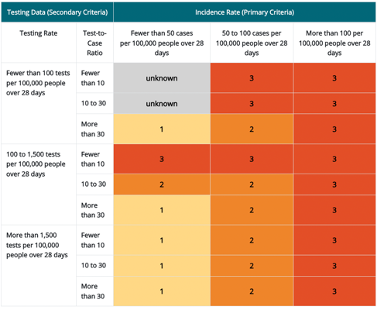
Travel Health Notice levels 1 through 3 for destinations with a population more than 100,000 people. Levels are based on combined 1) incidence rate (primary criteria) and 2) testing data (secondary criteria)
This image has an empty alt attribute; its file name is Infographic-COVID1.png

*Incidence rate is the primary criteria for destinations with a population more than 100,000 people. Testing data are the secondary criteria and that data includes both the testing rate (column 1) and test-to-case ratio (column 2). The resulting THN levels are shown in rows 3–11 of columns 3–5.

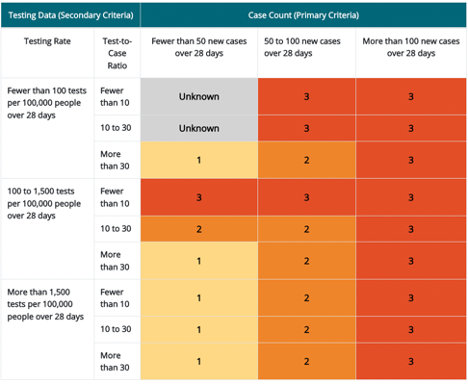
Travel Health Notice levels 1 through 3 for destinations with a population of 100,000 people or fewer. Levels are based on combined 1) case count (primary criteria) and 2) testing data (secondary criteria) *
This image has an empty alt attribute; its file name is Infographic-COVID2.png

*Case count is the primary criteria for destinations with a population fewer than or equal to 100,000 people. Testing data are the secondary criteria and that data includes both the testing rate (column 1) and test-to-case ratio (column 2). The resulting THN levels are shown in rows 3–11 of columns 3–5.

Population testing rates of more than 1,500 tests per 100,000 people over 28 days are considered sufficient to provide an accurate representation of COVID-19 in the destination. Rates less than or equal to 1,500 tests per 100,000 people over 28 days may signify concerns that testing is insufficient and may not provide an accurate representation of the incidence rate in the destination. The cutoffs for evaluating population testing ratesexternal icon have been adapted from the WHO guidelines.

The WHO determined a test-to-case ratio greater than or equal to 10 as the minimum indicator of sufficient surveillance capacity. A test-to-case ratio of less than 10 tests per case might indicate restrictive testing, or that only symptomatic people are being tested and undercounting the incidence rate (primary criteria). The preferred level is a test-to-case ratio of more than 30. The cutoffs for evaluating test-to-case ratios pdf icon[PDF – 18 pages]external icon have been adapted from the WHO guidelines.

When both the population testing rates and test-to-case ratios are high, CDC has confidence in a destination’s reported incidence. If either the population testing rate or test-to-case ratio is low, CDC has less confidence that the reported incidence accurately depicts the COVID-19 situation in the destination. In this situation, CDC adjusts a destination’s THN level as shown in the tables above. Countries with low incidence and testing rates are classified as unknown as well as countries that report data infrequently.

Level Unknown Travel Health Notices are determined as follows:

If a destination has insufficient data to make a THN level determination, its THN level is designated as “unknown”. Insufficient data means that the destination does not provide data or that the provided data are non-representative of the COVID-19 situation in the destination, making an accurate THN level determination difficult. This situation includes destinations with low COVID-19 incidence and low reported COVID-19 testing levels.

Raising a Travel Health Notice

CDC raises a destination’s THN level when the incidence rate (or case count) and testing metrics meet the THN threshold for a higher level and remain at that level for 14 consecutive days. The THN level may be raised before 14 days if there is a large increase in COVID-19 cases reported.

Lowering a Travel Health Notice

CDC lowers a destination’s THN level when the incidence rate (or case count) and testing metrics meet the THN threshold for a lower level and remain at that level for 28 consecutive days. Vaccination coverage rates and case trajectory will be considered when determining if the THN level can be lowered before 28 days.

For more information, visit How CDC Determines the Level for COVID-19 Travel Health Notices | CDC

Success Story: Darlene Meenach

April 21, 2022

South Shore Nursing and Rehabilitation is excited to recognize resident Darlene Meenach’s Success Story!

 Mrs. Meenach came to us in December 2021 after a few hospitalizations. She struggled with respiratory failure and just was not recovering. Even after admitting, she still struggled to get back to baseline for a month or longer. However, Mrs. Meenach soon got stronger and she became the funny, feisty lady that we all fell in love with! She made us laugh so much and we were sad, but happy when she decided it was time to go home. Mrs. Meenach is from here locally, and so many of the Care Team members knew her and her family. It was such a pleasure for us to have been able to care for Mrs. Meenach. We wish her well as she returns home. She did say she would be back to visit and we do hope she will soon! We hope she knows that she found a way to our hearts, and that she will be dearly loved for a long time. Good luck, Darlene!

Testing Strategies for COVID-19

April 18, 2022

Diagnostic Testing

Diagnostic testing is intended to identify current infection in individuals and should be performed on anyone that has signs and symptoms consistent with COVID-19 and/or following recent known or suspected exposure to SARS-CoV-2.

Examples of diagnostic testing include:

  • Testing anyone with symptoms consistent with COVID-19
  • Testing vaccinated and unvaccinated people who were exposed to someone with a confirmed or suspected case of COVID-19

Screening Testing

Screening tests are intended to identify people with COVID-19 who are asymptomatic and do not have known, suspected, or reported exposure to SARS-CoV-2. Screening helps to identify unknown cases so that measures can be taken to prevent further transmission.

Examples of screening include testing:

  • Employees in a workplace setting
  • Students, faculty, and staff in a school setting
  • A person before or after travel
  • Someone at home who does not have symptoms associated with COVID-19 and no known exposures to someone with COVID-19

Public Health Surveillance Testing

Public health surveillance is the ongoing, systematic collection, analysis, and interpretation of health-related data essential to the planning, implementation, and evaluation of public health practice. See CDC’s Introduction to Public Health Surveillance.

Public health surveillance testing is intended to monitor community- or population-level outbreaks of disease, or to characterize the incidence and prevalence of disease. Surveillance testing is performed on de-identified specimens, and thus, results are not linked to individual people. Public health surveillance testing results cannot be used for individual decision-making.

Public health surveillance testing may sample a certain percentage of a specific population to monitor for increasing or decreasing prevalence, or to determine the population effect from community interventions such as social distancing. An example of public health surveillance testing is when a state public health department develops a plan to randomly select and sample a percentage of all people in a city on a rolling basis to assess local infection rates and trends.

Regulatory Requirements for Diagnostic, Screening, and Public Health Surveillance Testing

Any laboratory or testing site that performs diagnostic or screening testing must have a Clinical Laboratory Improvement Amendments (CLIA) certificate and meet all applicable CLIA requirements. For more information, see the Centers for Medicare & Medicaid Services CLIA websiteexternal icon. Tests used for SARS-CoV-2 diagnostic or screening testing must have received an Emergency Use Authorization from the U.S. Food and Drug Administration (FDA) or be offered under the policies in FDA’s Policy for COVID-19 Testsexternal icon.

Tests used for SARS-CoV-2 public health surveillance on de-identified human specimens do not need to meet FDA and CLIA requirements for diagnostic and screening testing.

Reporting Diagnostic, Screening, and Public Health Surveillance Testing Results

Both diagnostic and screening testing results should be reported to the people whose specimens were tested and/or to their healthcare providers.

In addition, laboratories that perform diagnostic and screening testing must report positive diagnostic and screening test results to the local, state, tribal, or territory health department in accordance with Public Law 116-136, § 18115(a), the Coronavirus Aid, Relief, and Economic Security (CARES) Act. As of April 4, 2022, laboratories are no longer required to report negative results for non-NAAT tests (rapid or antigen test results). The Department of Health and Human Services published guidance on COVID-19 Pandemic Response, Laboratory Data Reporting: CARES Act Section 18115pdf iconexternal icon that specifies what data, in addition to test results, laboratories and testing sites should collect and electronically report.

Public health surveillance testing results cannot be reported directly to the people whose specimens have been tested and are not reported to their healthcare providers. Public health surveillance testing results (test results that are de-identified) can be reported in aggregate to local, state, tribal, or territory health departments upon request. Results from testing that is performed outside of a CLIA-certified facility or without an FDA-authorized test can only be reported to a health department if those results are used strictly for public health surveillance purposes, and not used for individual decision making.

Summary of Testing for COVID-19

 DiagnosticScreeningPublic Health Surveillance
SymptomaticYesNoN/A
Unvaccinated or vaccinated with known or suspected exposureYesNoN/A
Unvaccinated and Asymptomatic without Known or Reported Suspected ExposureNoYesN/A
Characterize Incidence and Prevalence in the CommunityN/AN/AYes
Testing of Personally Identifiable SpecimensYesYesNo
Results may be Returned to IndividualsYesYesNo
Results Returned in Aggregate to Requesting InstitutionNoNoYes
Results Reported to State Public Health DepartmentsYesYesIf requested
Testing can be Performed in CLIA-Certified LaboratoryYesYesYes
Testing can be Performed in a Non-CLIA-Certified LaboratoryNoNoYes
Test System Must be FDA Authorized or be Offered under the Policies in FDA’s GuidanceYesYesNo

To learn more, please visit https://www.cdc.gov/coronavirus/2019-ncov/lab/resources/sars-cov2-testing-strategies.html

COVID-19 Orders, Laws, and Regulations

April 11, 2022

To help prevent the spread of COVID-19 and help our country cope during the pandemic, CDC has occasionally issued legally binding orders and regulations.

People must wear face masks in indoor areas of public transportation traveling into, within, or out of the United States and indoors at U.S. transportation hubs, including airports.

Air passengers, 2 years or older, traveling to the United States from another country must present a negative COVID-19 test result or documentation of recovery from COVID-19 before boarding their flights. Regardless of vaccination status, passengers ages 2 or older are required to present a negative COVID-19 viral test result from a sample taken no more than 1 day before travel. Alternatively, passengers may present documentation showing that they tested positive for COVID-19 on a sample taken within the past 90 days and have been cleared to travel (documentation of recovery).

CDC issued an Order to implement the President’s direction on safe resumption of global travel during the COVID-19 pandemic and provided guidance to airlines, other aircraft operators, and passengers in Technical Instructions and Frequently Asked Questions.

All non-U.S.-citizen, non-immigrants, with limited exceptions, traveling to the United States by air must be fully vaccinated and show proof of vaccination.

CDC issued an Order on October 25, 2021 requiring airlines and other aircraft operators to collect contact information for passengers before they board a flight to the United States from a foreign country. The purpose of collecting this information is to identify and locate passengers who may have been exposed to a person with a communicable disease for public health follow-up. Airlines will retain the information for 30 days and transmit the information to CDC upon request for contact tracing and public health follow-up to keep people safe.

Following a public health determination, the CDC Director is terminating the Order under 42 U.S.C. §§ 265, 268 and 42 C.F.R. § 71.40 suspending the right to introduce certain persons into the United States. The implementation of the termination of the Order will be on May 23, 2022.

CDC considered multiple factors in its public health assessment and finds that, at this time, the available COVID-19 mitigation tools, as well as the fact that 97% of the U.S. population lives in a county identified as having “low” COVID-19 Community Level, will sufficiently mitigate the COVID-19 risk for U.S. communities and make an order under 42 U.S.C. §§ 265, 268 and 42 C.F.R. § 71.40 no longer necessary. This Termination will be implemented on May 23, 2022, to enable the Department of Homeland Security (DHS) to implement appropriate COVID-19 mitigation protocols, such as scaling up a program to provide COVID-19 vaccinations to migrants, and prepare for full resumption of regular migration processing under Title 8 authorities.

The initial CDC Order Suspending Introduction of Certain Persons from Countries where a Communicable Disease Exists was issued on 3/20/2020 pdf icon[2.1 MB, 43 pages], extended on 4/22/2020external icon and extended and amended on 5/19/2020 pdf icon[136 KB, 12 pages]. The Order was replaced with the Order Suspending the Right to Introduce Certain Persons from Countries Where a Quarantinable Communicable Disease Exists on 10/16/2020external icon and replaced again on 8/2/2021 pdf icon[296 KB, 24 pages]. This Order and accompanying public health determination terminate all previous orders.

During the COVID-19 pandemic, CDC issued an order suspending the right to introduce certain noncitizens attempting to enter the U.S. from Canada or Mexico (regardless of country of origin) at or between ports of entry. CDC has terminated the Order with respect to unaccompanied noncitizen children.

To learn more, please visit https://www.cdc.gov/coronavirus/2019-ncov/cdcresponse/laws-regulations.html.

CDC Expands Eligibility for COVID-19 Booster Shots

April 6, 2022

On October 21, 2021, CDC Director Rochelle P. Walensky, M.D., M.P.H., endorsed the CDC Advisory Committee on Immunization Practices’ (ACIP) recommendation for a booster shot of COVID-19 vaccine in certain populations. The FDA’s authorization and CDC’s recommendation for use are important steps forward as we work to stay ahead of the virus and keep Americans safe.

For individuals who received a Pfizer-BioNTech or Moderna COVID-19 vaccine, the following groups are eligible for a booster shot at 6 months or more after their initial series:

  • 65 years and older
  • Age 18+ who live in long-term care settings
  • Age 18+ who have underlying medical conditions
  • Age 18+ who work or live in high-risk settings

For the nearly 15 million people who got the Johnson & Johnson COVID-19 vaccine, booster shots are also recommended for those who are 18 and older and who were vaccinated two or more months ago.

There are now booster recommendations for all three available COVID-19 vaccines in the United States. Eligible individuals may choose which vaccine they receive as a booster dose. Some people may have a preference for the vaccine type that they originally received, and others may prefer to get a different booster. CDC’s recommendations now allow for this type of mix and match dosing for booster shots.

Millions of people are newly eligible to receive a booster shot and will benefit from additional protection. However, today’s action should not distract from the critical work of ensuring that unvaccinated people take the first step and get an initial COVID-19 vaccine. More than 65 million American remain unvaccinated, leaving themselves- and their children, families, loved ones, and communities- vulnerable.

Available data right now show that all three of the COVID-19 vaccines approved or authorized in the United States continue to be highly effective in reducing risk of severe disease, hospitalization, and death, even against the widely circulating Delta variant. Vaccination remains the best way to protect yourself and reduce the spread of the virus and help prevent new variants from emerging.

The following is attributable to Dr. Walensky:

“These recommendations are another example of our fundamental commitment to protect as many people as possible from COVID-19. The evidence shows that all three COVID-19 vaccines authorized in the United States are safe- as demonstrated by the over 400 million vaccine doses already given. An, they are all highly effective in reducing the risk of severe disease, hospitalization, and death, even in the midst of the widely circulating Delta variant.”

To learn more, visit https://www.cdc.gov/media/releases/2021/p1021-covid-booster.html

Post-COVID Conditions

March 29, 2022


Although most people with COVID-19 get better within weeks of illness, some people experience post-COVID conditions. Post-COVID conditions are a wide range of new, returning, or ongoing health problems people can experience four or more weeks after first being infected with the virus that causes COVID-19. Even people who did not have COVID-19 symptoms in the days or weeks after they were infected can have post-COVID conditions. These conditions can present as different types and combinations of health problems for different lengths of time.

These post-COVID conditions may also be known as long COVID, long-haul COVID, post-acute COVID-19, long-term effects of COVID, or chronic COVID. CDC and experts around the world are working to learn more about short- and long-term health effects associated with COVID-19, who gets them, and why.

Types of Post-COVID Conditions

New or Ongoing Symptoms

Some people experience a range of new or ongoing symptoms that can last weeks or months after first being infected with the virus that causes COVID-19. Unlike some of the other types of post-COVID conditions that tend only to occur in people who have had severe illness, these symptoms can happen to anyone who has had COVID-19, even if the illness was mild, or if they had no initial symptoms. People commonly report experiencing different combinations of the following symptoms:

  • Difficulty breathing or shortness of breath
  • Tiredness or fatigue
  • Symptoms that get worse after physical or mental activities (also known as post-exertional malaise)
  • Difficulty thinking or concentrating (sometimes referred to as “brain fog”
  • Cough
  • Chest or stomach pain
  • Headache
  • Fast-beating or pound heart (also known as heart palpitations)
  • Joint or muscle pain
  • Pins-and-needles feeling
  • Diarrhea
  • Sleep problems
  • Fever
  • Dizziness on standing (lightheadedness)
  • Rash
  • Mood changes
  • Change in smell or taste
  • Changes in menstrual period cycles

Multiorgan Effects of COVID-19

Some people who had severe illness with COVID-19 experience multiorgan effects or autoimmune conditions over a longer time with symptoms lasting weeks or months after COVID-19 illness. Multiorgan effects can affect many, if not all, body systems, including heart, lung, kidney, skin, and brain functions. Autoimmune conditions happen when you immune system attacks healthy cells in your body by mistake, causing inflammation (swelling) or tissue damage in the affected parts of the body.

While it is very rare, some people, mostly children, experience multisystem inflammatory syndrome (MIS) during or immediately after a COVID-19 infection. MIS is a condition where different body parts can become inflamed. MIS can lead to post-COVID conditions if a person continues to experience multiorgan effects or other symptoms.

Effects of COVID-19 Illness or Hospitalization

Hospitalizations and severe illness for lung-related diseases, including COVID-19, can cause health effects like severe weakness and exhaustion during the recovery period.

Effects of hospitalization can also include post-intensive care syndrome (PICS), which refers to health effects that begin when a person is in intensive care unit (ICU) and can remain after a person returns home. These effects can include severe weakness, problems with thinking and judgement, and post-traumatic stress disorder (PTSD). PTSD involves long-term reactions to a very stressful event.

Some symptoms that can occur after hospitalization are similar to some of the symptoms that people with initially mild or no symptoms may experience many weeks after COVID-19. It can be difficult to know whether they are caused by the effects of hospitalization, the long-term effects of the virus, or a combination of both. These conditions might also be complicated by other effects related to the COVID-19 pandemic, including mental health effects from isolation, negative economic situations, and lack of access to healthcare for managing underlying conditions. These factors have affected both people who have experienced COVID-19 and those who have not.

Prevention

The best way to prevent post-COVID conditions is to prevent COVID-19 illness. For people who are eligible, getting vaccinated against COVID-19 as soon as you can is the best way to prevent getting COVID-19 and can also help protect those around you.

Stopping a pandemic takes all the tools in our toolbox:

  • Get vaccinated and stay up to date on your COVID-19 vaccines.
  • Know when to wear a well-fitted mask to help protect yourself and others.
  • Avoid crowds and poorly ventilated indoor spaces.
  • Test to prevent spread to others.
  • Stay 6 feet apart from others who don’t live with you.
  • Wash you hands often with soap and water. Use hand sanitizer if soap and water aren’t available.

If you are NOT yet fully vaccinated, prevent long-term complications by protecting yourself and others from COVID-19.

Although media articles have reported that some people with post-COVID conditions say their symptoms improved after being vaccinated, studies are needed to determine the effects of vaccination on post-COVID symptoms.

What CDC is Doing

CDC continues to work to identify how common post-COVID conditions are, who is most likely to get them, and why some symptoms eventually improve for some people and may last longer for other people. Rapid and multi-year studies are underway to further investigate post-COVID conditions in more detail. These studies will help us better understand post-COVID conditions and how to treat patients with these longer-term effects.

For more information, please visit https://www.cdc.gov/coronavirus/2019-ncov/long-term-effects/index.html.

Success Story: Dale Young

March 28, 2022

South Shore Nursing and Rehabilitation is proud to recognize resident Dale Young’s Success Story!

Dale came to us in February after spending nearly 3 months in the hospital with sepsis and acute respiratory failure.  It was hard for Mr. Young at first.  He is from Augusta, KY, and he had no family close.  He didn’t let that stop him, though! He worked very hard with our therapy to get his strength back and was very determined to get back to his family. Mr. Young was very sweet and our Care Team loved having him here at the center. We want him to know how proud we are of him and his dedication.  If he ever gets back this way, we hope he stops in to see us again. Good Luck Mr. Young!

FAQs about Medical Consent and Booster Doses for Long-term Care Residents

March 18, 2022

A resource for Providers Participating in the CDC COVID-19 Vaccination Program, Long-term Care Residents & Their Families

In response to inquiries about medical consent surrounding the administration of a booster shot of Pfizer-BioNTech COVID-19 vaccine to residents in long-term care (LTC) settings at least five months after their Pfizer-BioNTech primary series, the Centers for Disease Control and Prevention (CDC) has developed the following responses to frequently asked questions (FAQs).

These FAQs are intended to clarify that medical consent is not required by federal law for COVID-19 vaccination in the United States.

Providers enrolled in the CDC COVID-19 Vaccination Program, including those administering vaccines to residents in LTC settings, are required by the CDC Provider Agreement to follow applicable state and territorial laws on medical consent. Providers should consult their legal counsel on such requirements.

Frequently Asked Questions

Is medical consent required for LTC residents to receive a booster shot of the Pfizer-BioNTech COVID-19 vaccine?

Medical consent is not required by federal law for COVID-19 vaccination in the United States.

COVID-19 vaccine providers should consult with their own legal counsel for state or territorial requirements related to consent; compliance with all applicable state and territorial laws is required under the CDC Provider Agreement.

The COVID-19 Provider Agreement contains the following requirements:

  • Before administering a COVID-19 vaccine with Emergency Use Authorization (EUA), the provider must provide the approved EUA fact sheet (or Vaccine Information Sheet, as applicable) to each vaccine recipient, the adult caregiver accompanying the recipient (as applicable), or other legal representative (as applicable). The fact sheet/information sheet explains risks and benefits of the particular COVID-19 vaccine and what to expect but is not a consent document.

Is consent required for the booster shot if consent was previously given for the Pfizer-BioNTech primary series?

Explaining the risks and benefits of any treatment to a patient – in a way that they understand – is the standard of care.

Providers should consult with their legal counsel to determine whether previous medical consent obtained from a resident or their representative is legally sufficient under the applicable laws of the state or territory for purposes of administration of a booster dose of Pfizer-BioNTech COVID-19 vaccine.

Is consent for a booster shot of the Pfizer-BioNTech COVID-19 vaccine required if the vaccine is being administered by a different provider?

Providers should consult with their legal counsel to determine whether consent for the Pfizer-BioNTech primary series previously obtained from an LTC resident or their guardian by a different provider is sufficient, or if consent should be obtained prior to administration of the booster shot of Pfizer-BioNTech vaccine, in accordance with any applicable laws of the state or territory.

Does CDC have a consent form that should be used to receive a COVID-19 vaccine?

No. Since applicable medical consent laws are a matter of state, tribal, or territorial law, providers are advised to consult with their legal counsel to assure compliance with the scope of those consent laws.

A written form is not needed if state law allows for oral consent and the organization/provider does not otherwise require it.

Your COVID-19 Vaccination

March 15, 2022
  • COVID-19 vaccines are safe and effective.
  • Everyone 5 years and older is now eligible to get a free COVID-19 vaccination.
  • Learn about different vaccines available.
  • Search vaccines.gov, text your zip code to 438829, or call 1-800-232-0233 to find COVID-19 vaccine locations near you.

Find a COVID-19 Vaccine

How do I get a COVID-19 Vaccine?

When You Get the Vaccine

What are the possible side effects?

Do I need a booster shot?

Register for v-safe

Vaccine Information for Specific Groups of People

What if I’m at risk for severe illness?

Can my child get vaccinated?

What if I’m pregnant or breastfeeding?

To learn more, please visit https://www.cdc.gov/coronavirus/2019-ncov/vaccines/your-vaccination.html.

Families and COVID-19

March 4, 2022

As more people are getting vaccinated and resuming activities they did before the pandemic, parents and caregivers are making hard decisions on how to protect their families. Not everyone is able to get vaccinated, so you may be confused about how to keep your family safe, especially if your family has vaccinated and unvaccinated members. Below are some things to consider when planning outings with your family.

What is Your Family’s Vaccination Status?

  • Everyone 5 years and older should get a COVID-19 vaccination to help protect against COVID-19.
  • People who are not up to date on their COVID-19 vaccines and children under 5 years old who are not able to get a COVID-19 vaccine should continue taking steps to prevent getting sick.
  • Everyone ages 2 years and older should properly wear a well-fitting mask indoors in public in areas where the COVID-19 Community Level is high, regardless of vaccination status.
  • In general, people do not need to wear masks when outdoors.
  • If you are sick and need to be around others, or are caring for someone who has COVID-19, wear a mask.
  • If the COVID-19 Community Level where you live is
    • Low
      • Wear a mask based on your personal preference, informed by your personal level of risk.
    • Medium
      • If you are at risk for severe illness, talk to your healthcare provider about wearing masks indoors in public.
      • If you live with or will gather with someone at risk for severe illness, wear a mask when indoors with them.
    • High
      • If you are 2 or older, wear a well-fitting mask indoors in public, regardless of vaccination status or individual risk (including in K-12 schools and other community settings).
  • If you are at risk for severe illness, wear a mask or respirator that provides you with greater protection.

Do You Have Family Member with Medical Conditions or a Weakened Immune System?

  • People with certain underlying medical conditions are at increased risk for severe illness from COVID-19.
  • People who have a condition or are taking medications that weaken their immune system may not be fully protected even if they are up to date with their COVID-19 vaccines. They should talk to their healthcare provider about what precautions may be needed.
  • If you are at increased risk for severe illness, or live with or spend time with someone at higher risk, speak to your healthcare provider about wearing a mask at medium COVID-19 Community Levels.

Where is Your Family Going?

  • Outdoor activities and settings are safer than indoor ones.
  • Avoid places that are poorly ventilated.
  • If someone in your family is younger than 2 years old or cannot wear a mask, limit visits with people who are not vaccinated or whose vaccination status is unknown and keep distance between your child and other people in public.

Regardless of which safer activities your family chooses, remember to protects yourself and others.

What are the Number of COVID-19 Cases and Vaccinated People in Your Community or the Community You are Visiting?

  • Use CDC Data Tracker to learn about the situation in your community.
  • If your community has a high number of COVID-19 cases or a low number of vaccinated people, consider choosing safer activities.

How to Talk to People Who Care for or Spend Time with Your Family Member

Learn how to talk to professional caregivers, extended family members, family friends, teachers, or other people your loved one spends time with about how to keep your loved one safe from COVID-19.

  • Check that your child’s school, childcare program, your family member’s adult care program, or other caregivers are taking the necessary steps to protect your loved ones in their care.
  • Tell them to encourage your family member to weak a mask indoors in public during times when the COVID-19 Community Level is high.
    • Caregivers can help model mask-wearing for children who are too young to get vaccinated.
  • Let caregivers know, as appropriate, if your loved one or someone they live with has an underlying medical condition or a weakened immune system.
  • Pack an extra mask in your child’s backpack. If your child is old enough, ask if your child can bring hand sanitizer from home to use when they cannot wash their hands with soap and water.

Helping Your Family Member Cope

As families participate in more activities, children or other family members may worry about themselves, their family, and friends getting sick with COVID-19. They may feel anxious about going to school, childcare, or normal activities like grocery shopping or gatherings. Parents, family members, and other trusted adults can help your loved one make sense of what they hear.

  • Make yourself available to listen and talk. Let your family member know they can come to you when they have questions.
  • Reassure your child or family member that they are safe.
  • Let them know it is okay if they feel upset. Share with them how you deal with your own stress so that they can learn how to cope from you.
  • Answer questions honestly and share facts about COVID-19 in a way that your family members can understand.
  • Teach children and other family members everyday actions to reduce the spread of germs.
    • Parents and caregivers can help by modeling these behaviors themselves.
  • Discuss with your family member any actions or routines that may be taken at school, childcare, adult care, or other activities to help protect them and others.
  • Take steps to protect you and your family’s mental health.
    • Try to keep up with regular routines.
    • Find safe ways to keep your family connected with friends and other family members.
    • Teach your family healthy coping skills by modeling them yourself. Take breaks, get plenty of sleep, exercise, and eat well.